
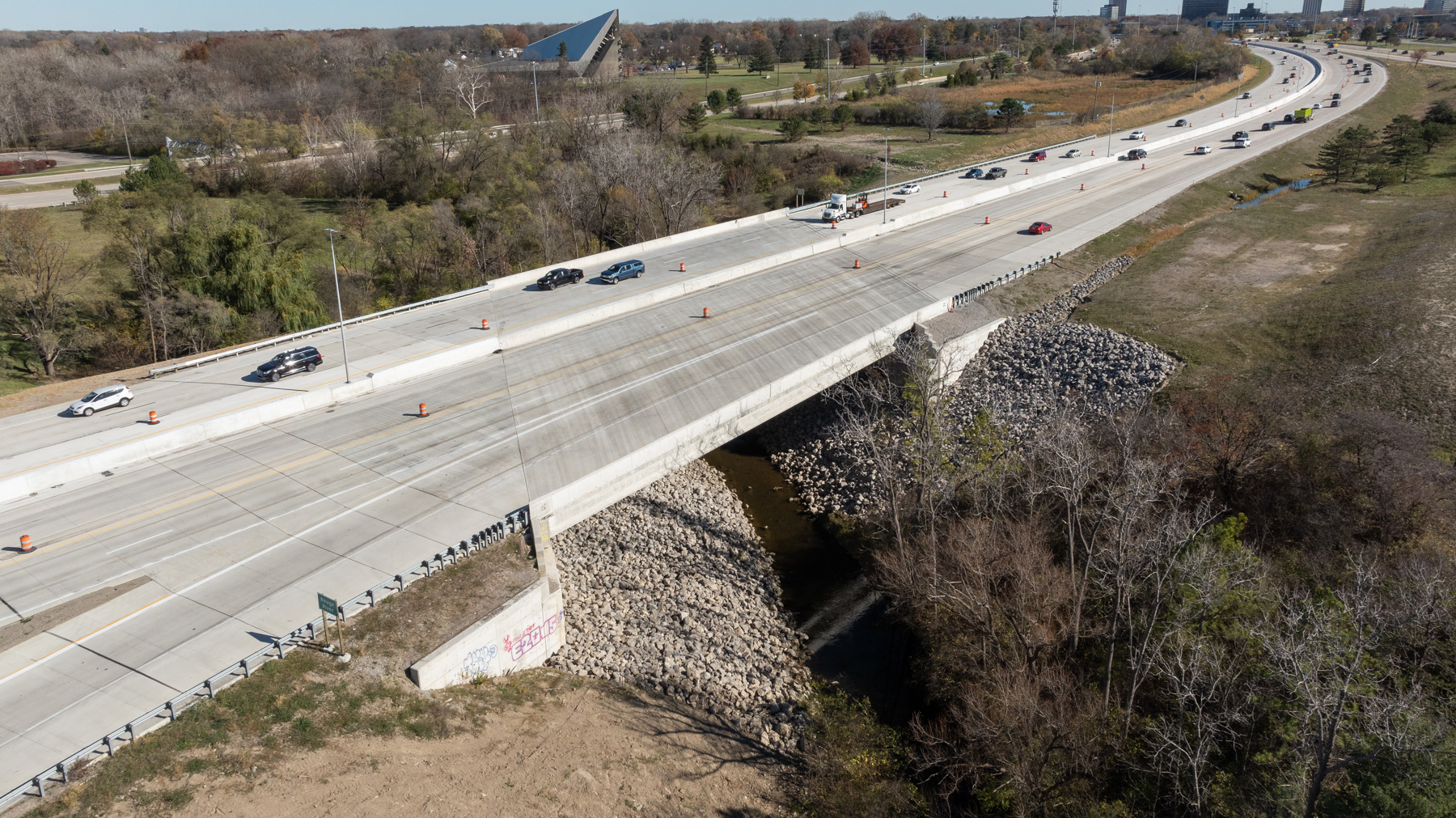
The Michigan Department of Transportation’s I-696 Model as a Legal Document Pilot Project demonstrated how intentional, effective collaboration can drive the success of innovative delivery methods. For this $22.9 million effort—one of the first of its kind nationally—Michigan DOT piloted the use of a model as a legal document on the I-696 bridges over the Rouge River. The project challenged all participants to work within a model-based environment, ultimately resulting in the successful replacement of two complex bridges. These replacements were critical components of the larger nine-mile I-696 freeway reconstruction and provided clear economic and quality-of-life benefits to local communities and commuters. The model-based delivery improved collaboration and clarity of design intent between designer and contractor. It also enhanced the resiliency of the scour-critical bridges and included design features to accommodate a future non-motorized path—helping reconnect communities long divided by the freeway corridor. Accurate and efficient bridge construction, enabled by the collaborative delivery approach, allowed the overall project to be completed on time and within budget. Approximately $9 million in preliminary engineering was federally funded, while construction of the roadwork and bridges was financed through state funds under Governor Whitmer’s “Rebuilding Michigan Bonding Program.” Remaining bridge rehabilitation work was supported by both state and federal funds. The Infrastructure Investment and Jobs Act ensured sufficient resources were available to apply the most appropriate solutions to both the bridges and the overall project.
 America's Transportation Awards